
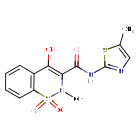
Generic name: Meloxicam (mel-ox-i-kam)
Brand names: Tab Melobest 2.5mg, Inj.Melonex
Dosage form: 0.5-mg/mL (0.02 mg per drop) oral suspension, 1.5-mg/mL (0.05 mg per drop) oral suspension, 0.5% (5-mg/mL) injection, and 2.5mg,5mg tablets (veterinary preparations) 7.5- and 15-mg tablets (human preparation).
Drug class: Non-steroidal Anti-inflammatory
Pharmacology and Mechanism of Action: Meloxicam has anti-inflammatory, analgesic, and antipyretic activity similar to other NSAIDs. Meloxicam works by inhibiting prostaglandin synthetase (cyclooxygenase 1 and 2) enzymes, which reduces the production of prostaglandins that typically trigger painful inflammatory responses. Since prostaglandins increase the sensitivity of neuronal pain receptors, blocking their production results in pain relief and reduced inflammation. While meloxicam primarily targets COX-2, it also has some effect on COX-1, which can lead to gastrointestinal irritation.
Pharmacokinetics: Meloxicam has a half-life of 23-24 hours in dogs, 30-40 hours in calves, and 8.5 hours (ranging from 5 to 14.5 hours) in horses. In cats, the half-life was 15 hours in experimental studies, but a larger pharmacokinetic study found it to be 26 hours, with a volume of distribution of 0.24 L/kg. Meloxicam is highly protein-bound(primarily to albumin). In dogs, oral absorption is nearly complete when taken with food. In horses, absorption ranges from 85% to 98% and is not significantly influenced by feeding. In ruminant calves, oral absorption is 100%, with a half-life of 20-43 hours, while in goats and sheep, absorption is 79% and 72%, respectively.
Route of elimination: Meloxicam is mainly eliminated through metabolism. Its metabolites are cleared through renal and fecal elimination.
Indications and Clinical Uses: Meloxicam is used to decrease pain, inflammation, and fever. -osteoarthritis, pain associated with surgery. Use in cats is limited to either short-term use or long-term use at low doses.
Instructions for Use:
Precautions: Kidney injury, especially in dehydrated animals or animals with preexisting renal disease. Gastrointestinal ulceration has been observed when dogs were administered doses slightly higher than registered doses. In cats at high doses (five times the dose), vomiting and other gastrointestinal problems were reported.
Dogs( For FDA-approved indications (osteoarthritis, analgesia, inflammatory conditions):
• 0.2 mg/kg (loading dose) PO, SC, or IV, and then 0.1 mg/kg q24h PO, SQ, or IV.
• Oral transmucosal spray (bioequivalent to oral suspension): 0.1 mg/kg sprayed in dog’s mouth once per day.
Cats
• 0.05 mg/kg q24h PO, with reduction in dose if chronic treatment is pursued. Long-term treatment may be reduced to 0.03 mg/kg q24h, or 0.05 mg/kg q48h, to 0.05 mg/kg q72h, PO.
• Single doses of 0.15 mg/kg SC may be administered for acute conditions. (There is Food and Drug Administration [FDA] approval in the US for single doses up to 0.3 mg/kg SC.)
[ For pain: For labeled indications: 0.3 mg/kg as a single one-time administration subcutaneous dose that should not be followed by additional doses of meloxicam or other
NSAIDs.
Note: The following dosages are extra-label in the USA and in 2010 the drug sponsor (BIVI-USA) and the FDA issued the following: WARNING: Repeated use
of meloxicam in cats has been associated with acute renal failure and death. Do not administer additional doses of injectable or oral meloxicam to cats. See
Contraindications, Warnings and Precautions for detailed information. ]
Pigs
• 0.4 mg/kg IM, which may be repeated in 24 hours.
Cattle
• 0.5 mg/kg q24h IV, IM, or SC.
Sheep and Small Ruminants
• 1 mg/kg, single dose, IV, IM, SC, or PO
Horses
• For inflammation and pain associated with musculoskeletal disorders or colic pain (IV): 0.6 mg/kg q24h IV or PO. In foals less than 7 weeks of age, the frequency may be increased to 0.6 mg/kg q12h because of more rapid clearance.
Ferrets:
For post-surgical pain: 0.2 mg/kg PO or SC once
For musculoskeletal and mild visceral pain:
- a) 0.2 mg/kg PO or SC q24h. Has a duration of action for 24–48 hours in most species; may be used for prolonged periods of time; also very effective when used in combination with opioids.
- b) 0.2–0.3 mg/kg PO q24h. Doses of 0.2 mg/kg once daily for 10 days was well tolerated by rabbits studied.
Birds:
a) As an analgesic: 0.5 mg/kg IM is also commonly used in birds and may be the safest of the NSAID analgesics for avian species. As the side effects of all
analgesics have not been studied in birds, these drugs should be used carefully in avian patients. (Echols 2008)
b) As adjunctive treatment for proventricular dilatation disease (PDD): 0.1–0.5 mg/kg PO q12h. (Oglesbee 2009)
Patient Monitoring and Laboratory Tests: Monitor for gastrointestinal symptoms such as diarrhea, bleeding, or ulcers. Due to the potential risk of renal damage, regularly check renal parameters, including water intake, blood urea nitrogen (BUN), creatinine levels, and urine-specific gravity, throughout the course of treatment.
Stability and Storage : These formulations remained stable for 28 days when stored at room temperature or under refrigeration.
Ref:
- Oglesbee, B. (2009). Vomiting & Diarrhea in Pet Birds: Where do I Start? Proceedings: WVC. Accessed via: Veterinary Information Network. http://goo.gl/waFP2
- Echols, M. (2008). Avian Anesthesia and Analgesia. Proceedings: IVECCS. Accessed via: Veterinary Information Network. http://goo.gl/kSQMJ